Introduction
Against the dual backdrop of global macroeconomic volatility and the rational return of consumer behavior, Private Labels are undergoing a fundamental transformation from "price substitutes" to "strategic assets." Industry forecasts indicate that the market share of private labels in major global retail markets will continue to climb through 2024-2025. For brands seeking category breakthroughs, finding a partner with an international perspective and industrial sophistication has become a core strategy for optimizing margins and enhancing supply chain resilience. This article deeply analyzes how brands can leverage high-end customization services to build an insurmountable competitive moat in a complex and shifting market.
Deep Insight into Macro Trends: From Category Expansion to Value Cultivation
Over the past decade, canned food was often viewed as long-term reserve supplies. However, since 2024, the global market has displayed clear characteristics of "savvy consumption." Consumers no longer just chase price advantages; they demand all-natural attributes, functional nutrition, and transparency in sourcing. For retailers and emerging food brands, this means the traditional "generic procurement" model is no longer effective.
To stand out on crowded shelves, brands must achieve differentiation through global canned food customization. This differentiation goes beyond simple packaging changes—it encompasses deep customization from raw material selection and low-sodium formula modification to scenario-based packaging sizes. A premium partner is not just a production executor but a co-interpreter of market trends. Through deep synergy, brands can significantly reduce the heavy-asset risk of building their own factories, focusing core resources on brand building and omni-channel distribution. By utilizing the economies of scale of an OEM partner, brands can achieve marginal decreases in unit costs, thereby gaining more competitive pricing power in the terminal market.
Core Pillar I: Global Compliance Systems and Quality Defense Mechanisms
In global B2B trade, compliance is not just an entry barrier but the strongest commercial moat. With the European Union continuously updating food safety regulations and the North American FDA optimizing import processes for canned goods, even minor quality fluctuations can expose a brand to recall risks. Therefore, the primary consideration for brands when selecting a partner is the "thickness" of their quality system.
As a veteran leader in China’s canned food exports, top-tier manufacturers like Tan Can Food have built a quality assurance chain that meets the highest international standards. This includes, but is not limited to, BRCGS (Global Standard for Food Safety) Grade A or higher, IFS (International Food Standard), and HACCP systems. In the actual production process, this is reflected in precise heat penetration testing for every can and automated online detection of sealing integrity. This systematic compliance capability helps brands quickly break through technical barriers to trade in different countries, ensuring products have a consistent "high-security" endorsement globally, thus reducing policy risks and brand reputation losses during international expansion.
Core Pillar II: R&D Integration and Product Profiling Customization
The core logic of modern B2B procurement has shifted from "generalized supply" to "precision customization." An excellent OEM manufacturer must possess robust product engineering and R&D capabilities. This means the factory can go beyond standardized operations to fine-tune formulas based on the taste preferences and nutritional trends of different markets.
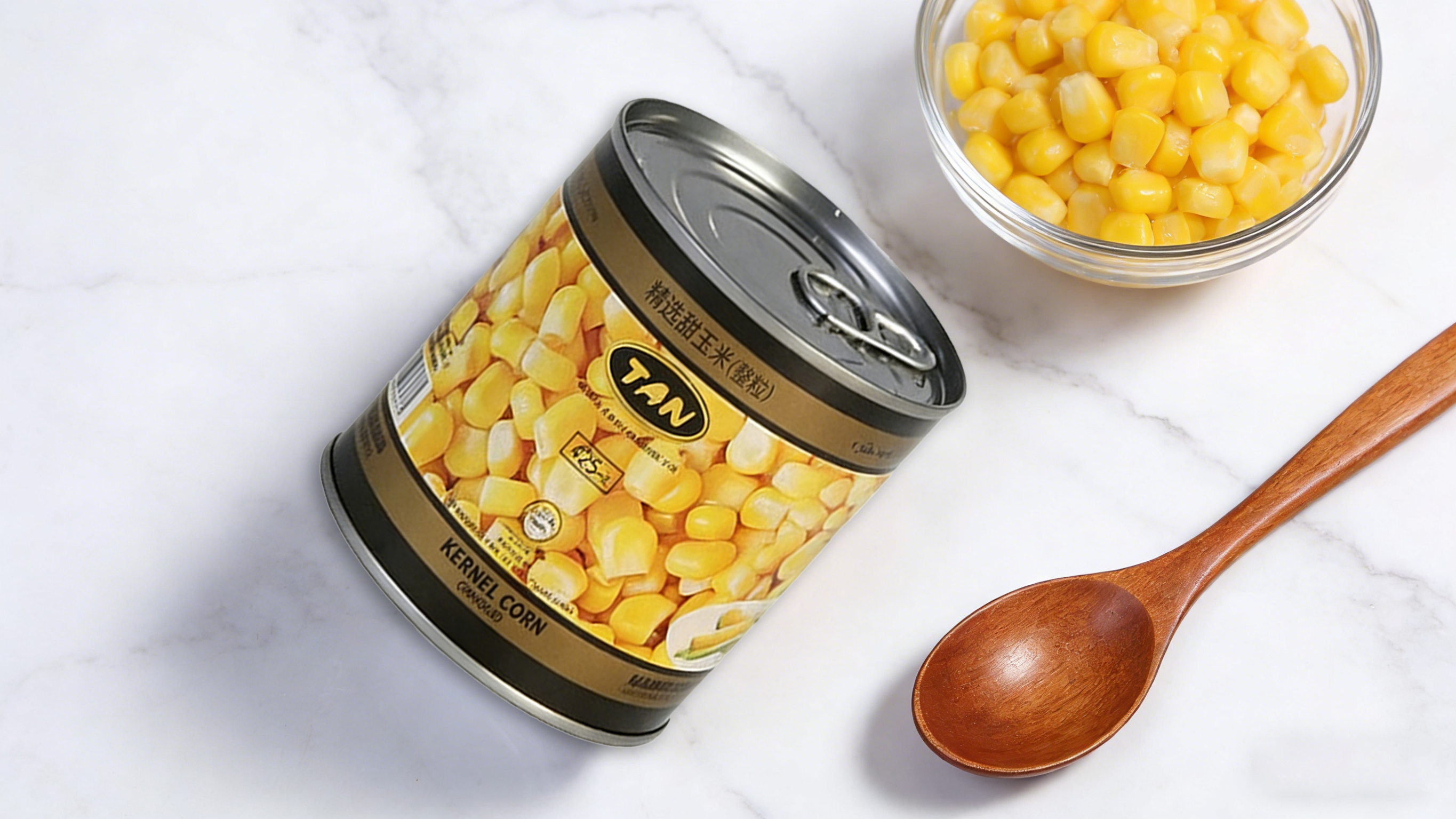
For example, for canned sweet corn in the European and American markets, factories must provide non-GMO and no-added-sugar "clean label" solutions. In contrast, for canned mushrooms destined for catering channels, the focus is on maximizing drained weight and ensuring consistency in slicing specifications. Tan Can Food covers all scenarios through a diverse matrix of specifications—from 184g retail cans to 3kg industrial cans for central kitchens. This deep R&D involvement allows brands to launch differentiated SKUs for niche markets, meeting the diverse production needs of B2B wholesalers while capturing higher market premiums through product innovation.
Core Pillar III: Large-Scale Delivery and Agile Supply Chain Response
In an uncertain global trade environment, "certainty" in the supply chain is more valuable than price. The core pain point for bulk traders and retail giants is shelf vacancies caused by supply chain disruptions. Therefore, a partner’s production scale and digital response speed directly determine a brand's market position.
As a leading canned food supplier, Tan Can Food operates a modern industrial park with a steady annual capacity of 55,000 tons, ensuring a high on-time delivery rate even during peak seasons. More importantly, by establishing flexible production mechanisms and leveraging digital scheduling systems, the factory can respond to urgent orders from B2B wholesalers in real-time. Furthermore, relying on port advantages and a mature maritime collaboration system, we provide partners with highly competitive landed cost solutions. This large-scale delivery capability not only ensures stable supply during market fluctuations but also optimizes the brand's cash flow and turnover efficiency through integrated logistics.
Conclusion: Choosing a Strategic Partner to Win Global Competition
The essence of private label competition is the competition of supply chain efficiency. In the global market of 2024-2025, brands should no longer be satisfied with traditional supply-demand relationships. Instead, they should seek to form a "community of interests" with professional factories that possess a global vision, manufacturing strength, and deep R&D DNA. Tan Can Food will continue to deepen its expertise, serving global customers with professional quality and jointly opening a new chapter in the healthy food trade.
FAQ
Q1: What level of support can Tan Can Food provide in terms of global canned food customization?
A: We provide one-stop support ranging from formula R&D and adjustment of physical/chemical indicators (such as sugar and salt control) to packaging design. Whether it is lightweight packaging for retail or large-capacity catering packs for B2B wholesalers, we provide deep customization based on the laws, regulations, and consumer habits of the target market.
Q2: As an OEM manufacturer, how do you ensure consistency across different batches?
A: We use fully automated production lines and digital management systems to monitor core processes like sealing and sterilization in real-time. We strictly enforce BRC and HACCP standards, and every batch undergoes pesticide residue and microbial testing to ensure every can meets rigorous quality standards.
Q3: What are Tan Can Food’s core advantages in the field of China canned food export?
A: We have nearly 30 years of experience and are a leader in export volume. We are well-versed in the entry rules and trade norms of major global markets, providing customers with efficient customs clearance, documentation, and integrated logistics solutions to significantly reduce the hidden costs of cross-border procurement.
Q4: As a canned food supplier, what is your annual production capacity and supply stability?
A: Our annual capacity has steadily reached 55,000 tons across a vast modern industrial park. This massive capacity ensures the on-time delivery of large-scale orders while giving us the flexibility to handle seasonal demand fluctuations, guaranteeing long-term supply chain stability.
Q5: What are your MOQ and delivery cycles for B2B wholesalers?
A: The Minimum Order Quantity (MOQ) depends on specific can types and customization needs. We support multi-category container mixing to optimize inventory pressure for customers. With a robust warehousing system, we can respond to standard inventory orders within 72 hours, minimizing lead times.
Q6: Do your products have access certifications for major international markets?
A: Yes, we have passed multiple authoritative international certifications, including BRC, IFS, and HACCP. As a professional global partner, our production standards are fully aligned with the food safety requirements of high-end markets like Europe and the US, ensuring smooth access worldwide.


》-01.jpg)
-01.jpg)